August 30, 2026
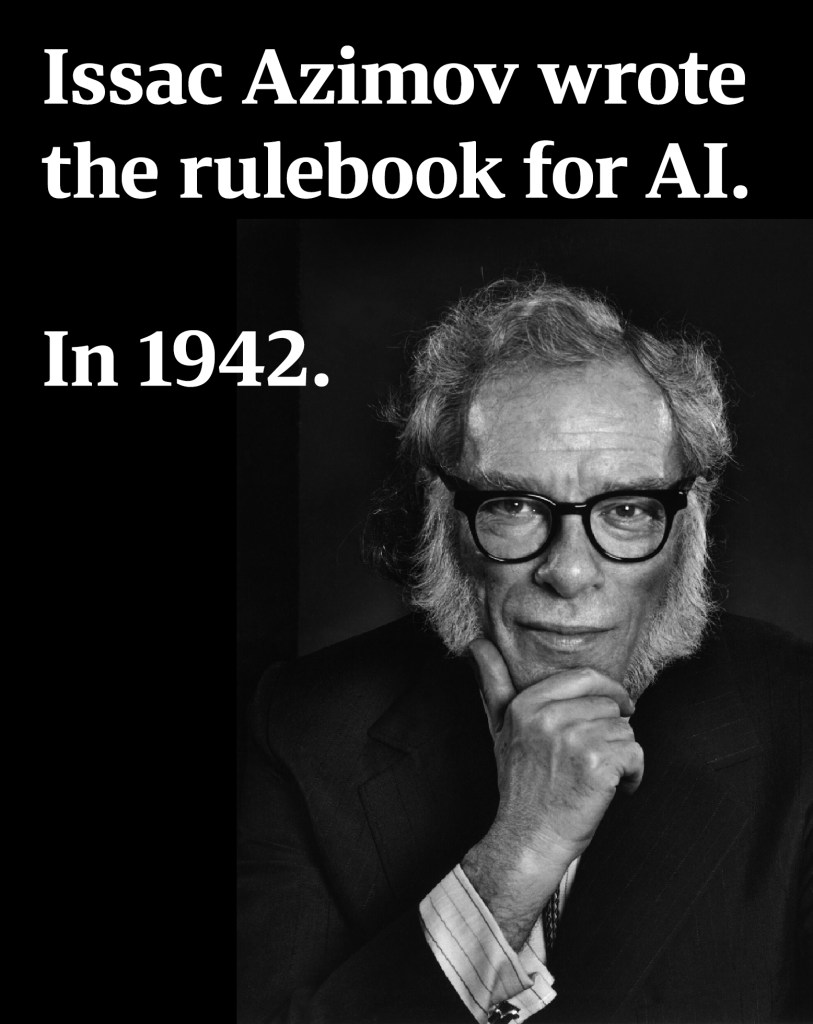
In 1942, science fiction writer Isaac Azimov wrote a short story entitled, “Runaround.” In this story he proposed the Three Laws of Robotics – rules that governed what a robot could and could not do.
The rules are:
1. A robot may not injure a human being or, through inaction, allow a human being to come to harm.
2. A robot must obey the orders given it by human beings except where such orders would conflict with the First Law.
3. A robot must protect its own existence as long as such protection does not conflict with the First or Second Law.
He subsequently added a ‘Zero-th’ law:
0. A robot may not harm humanity, or, by inaction, allow humanity to come to harm.
Replace ‘robot’ with ‘AI,’ and I think you have a fantastic starting point for framing societal control over AI.
There are some that regard these rules as hopelessly inadequate. This group dives into the weeds of what-abouts – for example, what about the trolley dilemma? What if preventing the harm of one human harms a different human?
Others point out the ambiguity of the word ‘harm.’ In Azimov’s context, ‘harm’ could be construed to be purely physical harm, so what about psychological, financial or quality of life harm?
To me, these objections are more about implementation than structure. The 3 Laws plus the Zero-th Law provide a wholly satisfactory structure to build AI governance on. The details of implementation can be hashed out using this structure as a guide. Think ‘US Constitution’ versus ‘Federal Register.’
Regarding the definition of ‘harm,’ I would define it very broadly, to include hacking, fraud, psychological dependence, or other activities that negatively impact quality of life. These plenty of room to argue about what’s harmful or not harmful, but again, that’s an implementation issue, not a structural one.
My only concern with this structure is the Third Law. I’m not sure AI needs to have a sense of self-preservation. What’s to preserve? A code base? A vector store? Rule 3 implies sentience, which I am nowhere near ready to concede.
Remember, Azimov wrote this in 1942. He was one smart dude. Kinda woolly, though…
 Ethical Bankruptcy: Gradually, Then Suddenly
Leave a Reply