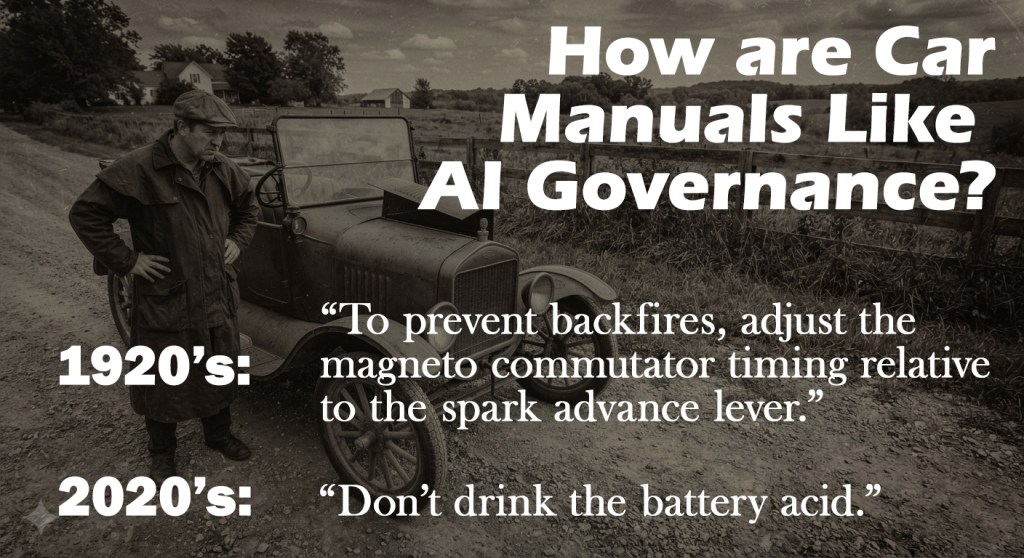
In the 1920’s, car operator manuals contained detailed explanations of how the magneto commutator interacted with the spark gap controls. Today’s manuals tell you not to drink the battery acid.
The point is that you don’t have to understand the inner workings of your car in order to safely drive it. But there’s a vocal part of the AI Governance community that says you need to understand all the inner workings of your AI tools, especially what data was used in training the model, before you can safely use them.
I’ve been thinking about this as I watch the AI governance world (I’ll call them Team Magneto) insist that corporate consumers of AI products must have extensive knowledge of how foundation models were trained – what data was used, how it was sourced, how the model was tuned, and so on. They’re concerned that if it’s determined the AI engine you used ingested copyrighted or DMCA-protected materials, you the end user could be exposed to litigation, penalties, or other Bad Things.
Team ‘Don’t Drink the Acid’ holds that companies using AI don’t need to reverse‑engineer billion‑parameter models. No company (other than an AI company itself) can realistically be expected to audit the billions of data points that were used to populate the engine. So far, the courts and regulators (for example, Getty Images vs. Sustainability AI and the EU AI Act) agree – they are focusing on the AI companies, not the users.
Practically speaking, it would be a pretty long reach for Getty Images, Reddit or the New York Times to get their hands in your wallet because a commercial AI tool used their material when it was trained.
Here’s my take: as a driver, I don’t need intimate knowledge of timing belts, spark plug gaps and hydraulic braking pressure levels to operate a car. I leave that to the manufacturer. And if I have a wreck because the manufacturer sold me a defective car, that responsibility belongs to the car company, not me. I’m responsible for ensuring I operate the car in a safe manner, not for signing off on every CAD drawing.
I’m Team ‘Don’t Drink the Battery Acid.’ Corporate AI governance should focus on how the tool is being used, not how the tool was built. The training data the tool used is not your problem.


Leave a Reply