In a few hours I’ll be saddlin’ up my pony and headin’ down the trail to Jonesboro – tomorrow is the big TEDx thing at Arkansas Sate. I’m rehearsed, rested and ready.
They are very serious about timing, so I have EXACTLY thirteen minutes to present. I’ve rehearsed this thing about 5 gagillion times and am coming in consistently at 12:50. Not a lot of safety margin, but I think I’ll be OK.
Good afternoon, and thank you for being here. My name is Randy Green. I have spent the last 40+ years in the IT consulting and banking businesses, and I was a partner in some very large accounting firms, including Arthur Andersen.
Today I’m going to tell you about the biggest financial scandal you’ve never heard of. It involves ethical collapses, bankruptcies, conflicts of interest, and a few other unsavory business things, most of which I experienced first-hand at Andersen and a company in Houston called Enron. This story isn’t specifically about that experience, but about the reason Andersen missed the Enron fraud. I’ve got an idea on how to fix it.
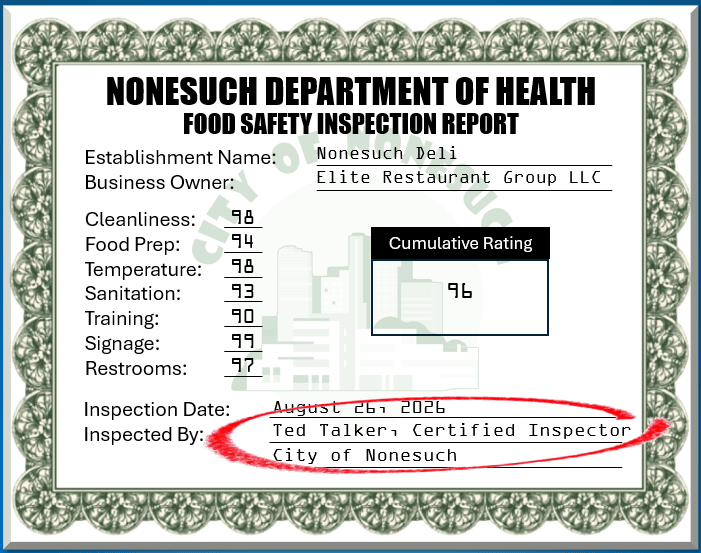
Imagine one day you walk into a franchise restaurant and see this health inspection certificate hanging on the wall. Looks pretty good – high scores across the board. One thing you may notice is who did the inspection – in this case, a certified city inspector. You’d probably feel pretty good about eating here.
Would you feel the same way if the certificate looked like this. Now the inspector is not an independent 3rd party, but the district manager of the franchise that owns the restaurant. It looks to me like the company is grading it’s own homework, and I’m not so sure about those scores now. Are you?
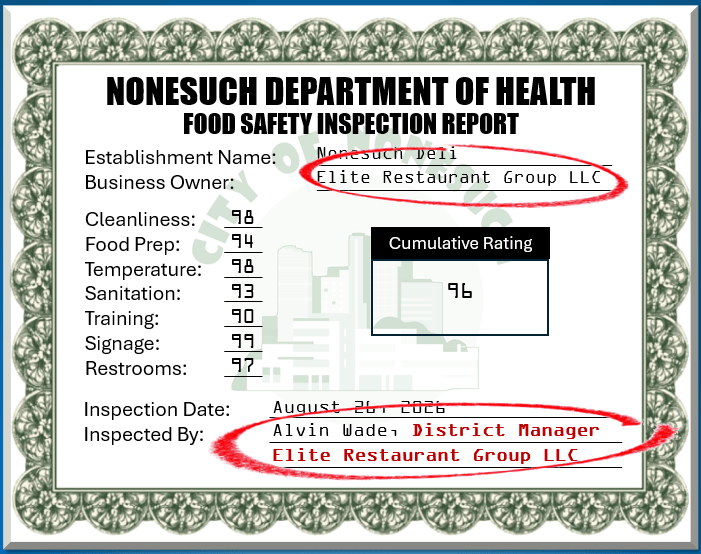
Well, believe it or not, this second certificate is pretty much the way audits work. Most people don’t know this, but auditors are hired and paid by the companies that they audit. It’s a fundamental conflict of interest. It’s like the inmates of a jail hiring and paying the guards.
Auditors are supposed to be ‘independent’ from their clients, but how can you be independent when you’re being paid by the people you’re auditing? This conflict puts auditors in an impossible position. Audits are highly subjective. It’s not just debits and credits – there are a lot of complex accounting rules that auditors have to make judgment calls on. And every time they make that call, they know that if the company they’re auditing doesn’t like it, they can fire or otherwise punish the auditor.
This lack of independence is what eventually brought down Andersen. Andersen got too close to Enron. How close? They actually had offices inside Enron’s world headquarters building. They followed Enron’s dress code. They effectively became part of the Enron team.
A lot of them eventually became Enron employees. Enron paid better than Andersen, and Andersen people knew that if they ever wanted to get a job at Enron, they better sing from the Enron hymnal. How likely are you to make a judgement call that Enron doesn’t like if you’re trying to get a job there?
Ultimately, it came down to dollars. Enron was a $52 million dollar client – one of Andersen’s biggest. The CFO of Enron was notorious for taking business away from companies unless they did what he told them to do. Andersen auditors knew about many of the sketchy things that Enron was doing. They also knew that calling Enron out on it would cost them millions. They chose to do what Enron wanted, and that decision led to the destruction of both companies. Over 50,000 people lost their jobs. I was one of them.
Auditors are critical players in the integrity of our financial system. And the way it works now, the integrity of our entire financial system depends on auditors being willing to act against their own self-interest. Let me repeat that. The integrity of our entire financial system depends on auditors being willing to act against their own self-interest.
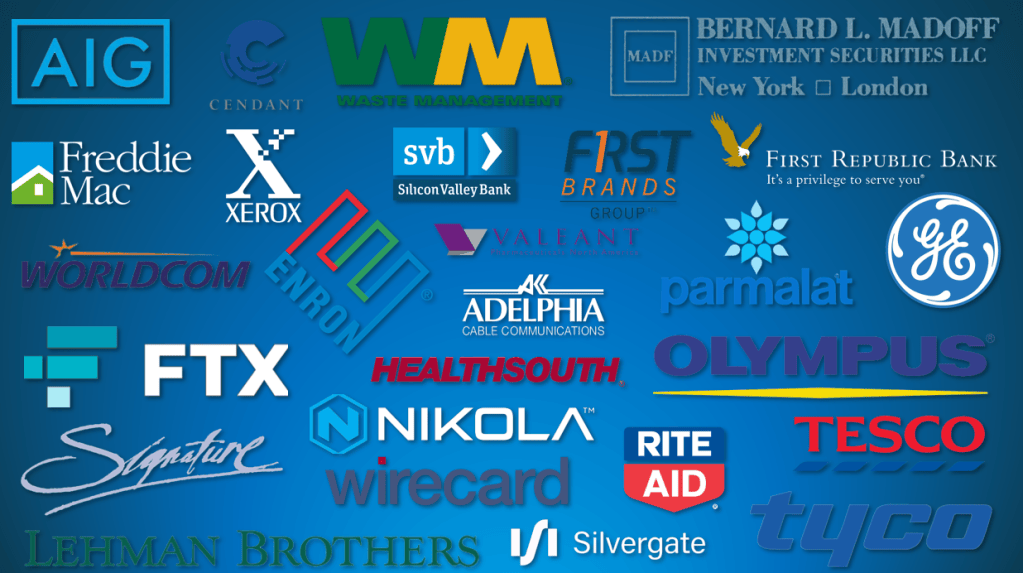
The result is very predictable.
Here’s a few logos you’ll recognize – but you’ll recognize them for the wrong reason. a trillion dollars in lost value – value that was lost because of fraud that wasn’t caught by auditors.
It’s pretty clear that the audit system is fundamentally flawed. So what do we do about it?
Well, let’s go shopping. Specifically, let’s go on a trip to your local grocery store and buy a gallon of milk. Now your grocery store, like many grocery stores, rents shelf space to the local dairy. The store never actually owns the milk – it just provides the platform where you and the dairy meet. That distinction is important.
Now suppose get home and discover your gallon of milk has gone bad. What do you do? You take it back to the store, and they either refund your money or replace it. Problem solved. But suppose your grocery store has a different philosophy – suppose they tell you that your sour milk is not their problem. They just provide a platform to connect you with the dairy.
They tell you, “If you’ve got a problem with the milk, you need to go talk to the dairy. You should really talk to the cow.”
That’s absurd. The store profits from the sale but accepts no responsibility for what it sold you. It’s not supposed to work that way. And the cow is very confused.
Now it turns out that there’s another type of business that operates like grocery stores – stock exchanges. They provide virtual shelf space for stocks, but they never own the stocks sold on their platform.
Suppose you bought stock in a company called FraudCo on the NASDAQ. Shockingly, FraudCo turns out to be a fraud. The company goes bankrupt and their stock goes to zero. Guess what happens if you call up NASDAQ and inform them that they sold you a bad stock?
They’ll tell you, ‘That’s not our problem. We’re just providing a platform. Go sue the company. Sue the auditors. Sue the regulators. Sue anybody, but us.’ But the exchange will happily keep the listing fees, keep the trading fees, and keep the profit. You – the investor – get to keep the loss.
But, see, it is the exchanges problem. The exchange facilitated the sale. It profited from the transaction. And the reason NASDAQ didn’t know FraudCo was a bad stock is that it didn’t want to know. They were willfully ignorant of what it was selling.
But wait – why are we talking about stock exchanges when the topic is auditing? It’s because we have to change the way the audit system is structured. And I believe stock exchanges are a critical part of that restructuring.
Here’s the answer. Instead of companies selecting, hiring and paying their auditors, stock exchanges should select, hire, and pay the auditors of the companies listed on the exchange.
How would this work? Companies that are listed on an exchange will pay an annual audit fee to the exchange. That money will go into a pool that the exchange manages. The exchange then sends requests for proposals to audit firms. Firms respond, and the exchange evaluates the responses and selects the best auditor for each company. The exchange then manages the audit.
Why is this better? It’s because it completely changes the client dynamic. Auditors no longer have to worry about keeping the company they are auditing happy, because that company is not their client. Their client is the exchange. The company being audited no longer has leverage over the auditor.
Exchanges will demand high-quality audits, because they can no longer claim ignorance. If they sell a bad stock, they own some of the responsibility for that sale. It is in their interest to rigorously audit the companies on their exchange. As investors, it’s in our interest too.
Interesting idea, right? What’s the result?
Three things.
First, Exchange accountability – exchanges now have skin in the game. They no longer get to wash their hands of responsibility when they handle a rotten stock.
Second, real auditor independence. The auditor is no longer auditing the company that pays them. If a company tells the auditor, “Hey, I’d appreciate it if you didn’t look too hard at the so-and-so account,” the auditor can now smile and say, “I don’t work for you. I work for the exchange. And thanks for telling me where to look.”
And lastly, and this is huge – you get something I call structural quality control. Auditors are still going to make judgment calls, but now they’re incented to err on the side of rigor, not on the side of leniency. The structure of the system encourages better audits.
This is a big change. And as the saying goes, the only thing that likes change is a wet baby. How could you even do this?
Let’s start by identifying who likes this idea, and who’s going to push back. The exchanges, auditors and companies being audited will not be fans. Why? Because they are very comfortable with the status quo, thank you very much.
Exchanges make money with no risk. Auditors have cozy, long-term relationships with clients. And the clients have “power of the purse” control over their auditors. It’s a pretty sweet deal, and breaking up this ‘unholy trinity’ will not be easy.
But you know who loves this idea? Every investor on the planet loves this idea. Everyone that has a 401-k, a pension, or has ever invested in stocks – people like you and me – wants to know the auditors are on our side, not the side of the company they are auditing. When enough of us investors rally to support this solution, we can fix this problem.
So here’s a three step plan to get started.
First, enlist academia and publish, publish, publish. A big hurdle for any new idea is always visibility, and academia is the logical place to get it. Get this idea into the business school classrooms, into the accounting journals, into the academic conversation.
Step 2 – engage and enlist our natural allies. Institutional investors. Regulators. Audit committees. Mid-tier audit firms who would gain a fair shot at major engagements. All of them love this approach.
Finally, as they saying goes, ‘Never waste a crisis.’ When the next major audit failure occurs – cough AI cough – push for congressional hearings and point out how this idea would have helped prevent it.
Let me wrap up. For the financial system to work effectively, auditors must be truly independent. They are not. This has to be fixed. If we don’t, there’s going to be more Enrons, Madoffs, and FTXs. Shame on us if we let that happen. There’s a saying that the only thing necessary for the triumph of evil is for good people to do nothing. Let’s not do nothing.
 Ethical Bankruptcy: Gradually, Then Suddenly