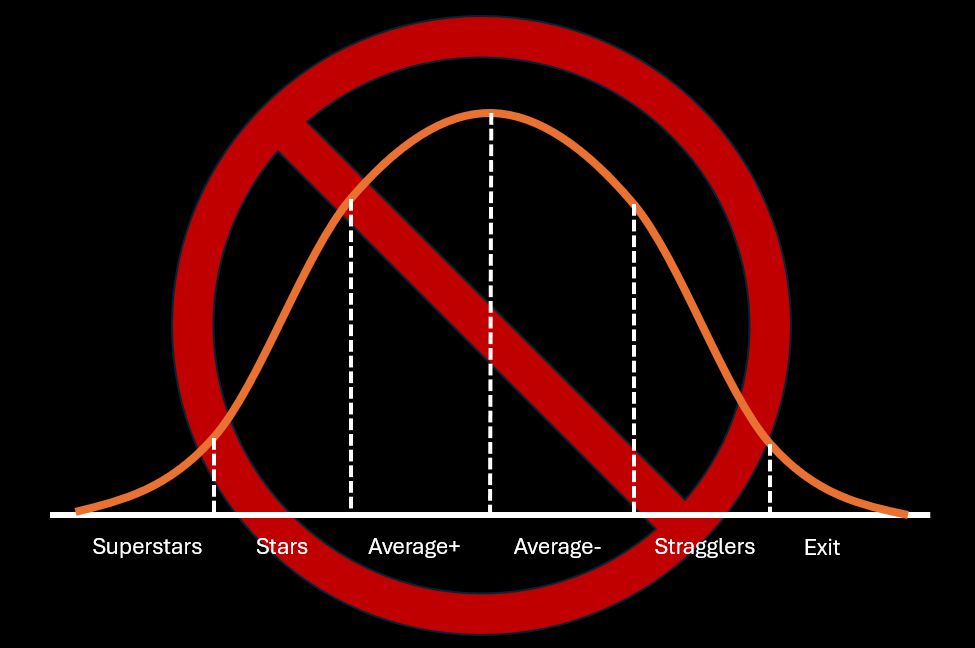
Something terrible is going to occur literally millions of times today. Something so demoralizing, useless, and backwards that it’s incredible that it still exists. And it’s something you’ve almost certainly participated in, and probably still bear scars from.
I’m speaking of the Annual Performance Review process, and all of its accompanying evils – the forced rating, the tyrannical bell curve, and the ‘rank and yank’ nightmare that comes with it.
Once a year, managers sit down with an employee and tell them about their performance for the entire year. It’s like a football coach waiting until the end of the season to tell his running back to stop fumbling so much.
Then, the managers get into a room and bargain – there’s no better word for it – to get their favorites ranked high.
At the end of the ranking meeting, after every employee has been rated from ‘Superstar’ to ’Fire Tomorrow,’ HR will review the distribution and demand it fit a bell curve. The arguments continue until rankings fit the curve, or everyone collapses in a mix of dejection, disgust, and exhaustion.
It would be hard to create a better technique to discourage cooperation and teamwork. Employees quickly figure out that if they help a teammate, they create more competition for themselves at evaluation time. It forces employees to compete with each other, rather than work together.
A 2008 study of brain scans done by the NeuroLeadership Institute showed that when a person is given a static numerical rating – “You are a 3 out of 5” – the brain triggers a response identical to physical pain. Even better, the prefrontal cortex – the part of your brain responsible for creativity and problem-solving – literally shuts down. What a great way to improve productivity!
Then there’s the rank-trading. “OK, I’ll give in to rating Bob a 3 instead of a 2, but you have to bump Sally from a 1 to a 2 so that I can move Steve from a 2 to a 1.”
It’s like an HR version of ‘Uno’ – discard a ‘3’, draw 2, reverse …
The result is that the best negotiator (and/or the loudest voice in the room) gets their team the best ratings.
Why do we keep doing this? There is a simple, effective, and morale-boosting alternative – it’s called ‘frequent check-ins’. Rather than storing up all of the good things and bad things about an employee’s performance for an entire year, take 5 or 10 minutes every week or so and give them some real-time coaching and feedback.
And on what planet is talent perfectly distributed in each team? If someone meets Star criteria, they are a Star. It’s irrelevant what others in the team are rated.
My grandfather used to tell the story about the man who repeatedly hit himself in the head with a hammer. When asked why, he replied, “because it feels so good when I stop.” I’d like to invite us, as leaders and managers, to put down the hammer. Cancel the ranking meeting. Burn the forms. And talk to your people!
 Ethical Bankruptcy: Gradually, Then Suddenly
Leave a Reply